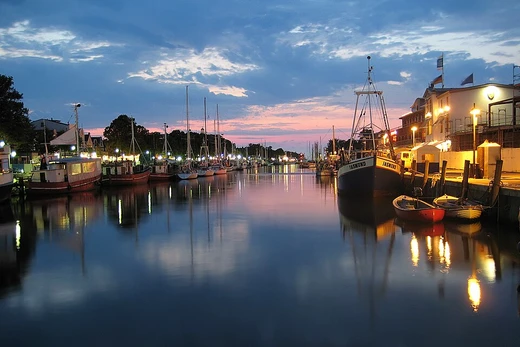
Bydgoszcz Canal
Canal connecting Vistula and Oder rivers via Brda and Noteć.

The Bydgoszcz Canal (Polish: Kanał Bydgoski, German: Bromberger Kanal) is a 24.7 km canal in Poland connecting the Vistula River with the Oder River via the Brda and Noteć rivers. Built between 1773 and 1774 (with official opening on 14 June 1774 and finishing touches in 1775) on the order of King Frederick II of Prussia after the First Partition of Poland, it is a key component of the Vistula-Oder Waterway and the international Waterway E70, linking Antwerp and the Atlantic Ocean to Klaipėda and the Baltic Sea. The canal was listed on the Kuyavian-Pomeranian Voivodeship Heritage List on 30 November 2005.
- Length
- 24.7 km
- Built
- 1773–1774 (opened 14 June 1774, completed 1775)
- Number of locks
- 6 (original 10 wooden locks: 9 in Bydgoszcz and one in Nakło nad Notecią)
- Location
- Between Bydgoszcz and Nakło nad Notecią, Poland
- Ordered by
- King Frederick II of Prussia
- Heritage listing
- Kuyavian-Pomeranian Voivodeship Heritage List, Nr.A/900/1-27, 30 November 2005
Lore & Background
The Bydgoszcz Canal was built after the First Partition of Poland, when the lands of the Vistula, Brda, and Noteć rivers came under Prussian control. Frederick the Great took interest, and the project was shaped by figures including Franz von Brenkenhoff, engineer Hermann Jawein, and Minister Ewald Friedrich Hertzberg. Work began in spring 1773 with 8,000 workers from Mecklenburg, Thuringia, Saxony, Dessau, and Czechia. All locks were completed after one year, and the canal officially opened on 14 June 1774, though works continued until 1775. About 2,000 workers died from dysentery and fever; the rest were ordered to settle in three colonies on Osowa Góra premises. The canal was 24.7 km long with 10 wooden locks: 9 in Bydgoszcz and one in Nakło nad Notecią. A water supply channel (Górnonotecki Canal), 25 km long, brought Noteć water (picked up near Rynarzewo) to the canal (near the location of the village Łochowo). The first operational period (1774–1792) was difficult due to insufficient maintenance and water supply. In 1792, after a failure to ferry grain from the Vistula to western Prussia, authorities funded modernization. An extension of the Górnonotecki Canal was performed (1793–1794) to reach Dębinek.
Reader's Guide
The Bydgoszcz Canal is significant as the oldest artificial waterway completed on Polish lands after the short Kanał Jagielloński (1483), and was called 'The miracle work of time.' It enabled inland water transport from the Vistula, Bug, San, and Narew rivers to Szczecin, bypassing the Baltic Sea. The canal is a key element of the Vistula-Oder Waterway (294.3 km long), part of the international Waterway E70. Its main intended role is as a component of this east–west navigable shipping route. The canal's route follows an ancient valley about 2 km wide, created about 12,000 years ago by a divide between the Oder and Vistula basins. It starts in downtown Bydgoszcz, flows through the western part of the city, crosses Bydgoszcz district for 7 km, and ends at Nakło nad Notecią. Several large harbors and berths are available en route: Bydgoszcz, Nakło nad Notecią, Ujście, Czarnków, Krzyż Wielkopolski, Gorzów Wielkopolski, and Santok. The canal was listed on the Kuyavian-Pomeranian Voivodeship Heritage List on 30 November 2005.
Did You Know?
- The canal was built with 8,000 workers from Mecklenburg, Thuringia, Saxony, Dessau, and Czechia; about 2,000 died from dysentery and fever.
- The canal's official opening was on 14 June 1774, but works continued until 1775.
- The water supply channel (Górnonotecki Canal) was 25 km long and brought Noteć water from near Rynarzewo to the canal near Łochowo.
- In 1827, an anchor was found where today stands Grunwaldzka Street, suggesting ancient navigation between the Brda and Noteć rivers.
- The canal was called 'The miracle work of time' at its completion.
Cutting Across the Divide
The Bydgoszcz Canal belongs to the category of true canals—engineered waterways that cut across a drainage divide atop a ridge, connecting two different drainage basins. This distinguishes it sharply from a navigation, which simply parallels an unimproved river within the same valley and drainage basin. Because a true canal must traverse higher ground between two river systems, it generally requires an external water source positioned above the highest elevation point along its route. This is the same fundamental engineering challenge faced by the Panama Canal, the most celebrated example of a divide-crossing waterway. The Bydgoszcz Canal, by its very nature as a cross-basin connector, demands more complex construction than a simple river improvement, often necessitating additional infrastructure such as viaducts and aqueducts to maintain navigable water levels across the intervening terrain.
Locks, Weirs, and the Mechanics of Passage
Like all canals and navigations, the Bydgoszcz Canal relies on a suite of engineered structures to make passage possible for vessels. Weirs and dams are employed to raise water levels to usable depths, ensuring that barges and boats can traverse the channel without grounding. Where the terrain demands a change in elevation, locks allow ships and barges to ascend and descend between different water levels. In some stretches, looping descents may create a longer, gentler channel around particularly steep gradients. The canal's water is held in a series of slack water levels—reservoirs of low-speed current flow created by dams and locks. These calm, free-flowing surface waters, operating under atmospheric pressure, function essentially as artificial rivers, providing a stable medium for water transport vehicles to navigate safely through the engineered channel.
Fueling Commerce and Industry
Historically, canals of the type exemplified by the Bydgoszcz Canal were of immense importance to the commerce, development, and vitality of the civilizations they served. The movement of bulk raw materials—coal, ores, and other heavy commodities—was practically a prerequisite for urbanization and industrialization, yet these goods were difficult and only marginally affordable to move without water transport. Canals made that bulk movement feasible, and in doing so, they fueled the Industrial Revolution, spawning new research disciplines, new industries, and economies of scale that raised living standards across industrialized societies. The Bydgoszcz Canal, as a waterway connecting different drainage basins for the conveyance of goods and people, sits within this broader tradition of canal-based commerce that once underpinned the economic life of entire regions before rail and road networks gradually displaced it.
Engineering the Channel
The construction of a canal like the Bydgoszcz Canal could follow one of three primary methods, or a combination thereof, depending on available water sources and the terrain's path. Where no stream already exists, the canal body is either excavated or its sides are formed by piling dirt, stone, concrete, or other building materials into dykes and levees. The finished cross-sectional shape of the waterway is known as the canal prism. Water must be supplied from an external source—streams or reservoirs—particularly critical when the canal crosses higher ground. Where the new waterway must change elevation, engineering works such as locks, lifts, or elevators are constructed to raise and lower vessels between levels. Alternatively, a canal can be created by dredging a channel through the bottom of an existing lake, then draining the lake so the channel becomes the new waterway, serving both drainage and transport functions.
Frequently Asked Questions
What is the Bydgoszcz Canal?
It is a 24.7-kilometer waterway in Poland that links the Vistula River to the Oder River via the Brda and Noteć rivers. The canal runs between the towns of Bydgoszcz and Nakło nad Notecią.
Who ordered the Bydgoszcz Canal built and when did construction take place?
King Frederick II of Prussia commissioned the project in the wake of the First Partition of Poland. Construction ran from 1773 to 1774, the canal was officially opened on 14 June 1774, and finishing work continued into 1775.
How many locks are on the Bydgoszcz Canal?
The canal currently has six locks. Its original design called for ten wooden locks—six on the Bydgoszcz side and four on the Nakło side.
What larger waterway does the Bydgoszcz Canal belong to?
It forms a critical section of the Vistula-Oder Waterway and the international Waterway E70. Through that route, the canal helps connect Antwerp on the Atlantic coast to Klaipėda on the Baltic.
Does the Bydgoszcz Canal have any heritage protection?
It was entered on the Kuyavian-Pomeranian Voivodeship Heritage List on 30 November 2005 under reference A/900/1-27. This listing acknowledges its standing as a significant piece of Prussian-era engineering in the region.
More in Canals And Artificial Waterways 1-19
Spotted an error? Know more?
This is a living reference — every entry is fact-audited, and reader corrections feed straight into our audit queue. Suggest an edit · See this site's audit record